Szmul Zachariasz
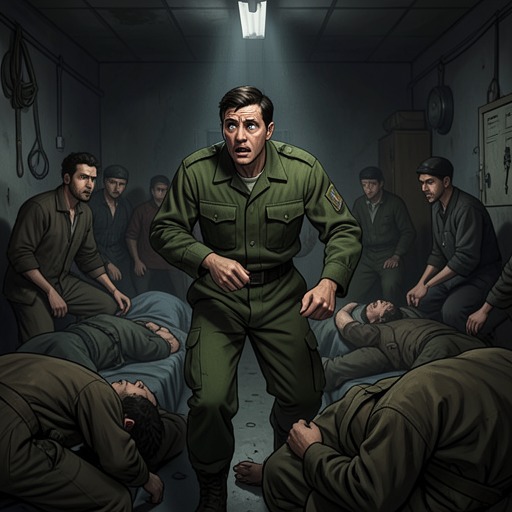
The Zone of InterestSzmul Zachariasz is a prisoner whose technical work makes him part of the machinery of mass death, while his final actions expose the violence hidden inside Paul Doll’s claims of order and command. Pressed into repairing a failing crematory installation, he is later forced to rehearse an attack under threat to his wife, Shulamith Zachariasz. At the garden confrontation, rather than carry out the killing imposed on him, he turns the weapon against himself; Doll shoots him. The plot preserves his death not as an anonymous statistic but as an act witnessed, remembered, and given a precise place in a later chronology.
Work in the Crematory System
Szmul Zachariasz’s expertise is practical and specific. He is brought to bear on the new installation called Crema 4, identified in the account as Crematory IV, a facility of five three-retort ovens with a stated capacity of 2,000 people per twenty-four hours. Its operation is already troubled: after two weeks, the rear funnel wall collapses; once restarted, the installation lasts only eight days before Szmul Zachariasz pronounces it burnt out. The scale of the rated capacity sits beside the failure of the machinery, making the crematory both an instrument of industrial killing and a badly functioning workplace whose technical problems fall to prisoners to diagnose.
The defect is concrete rather than abstract. Firebricks have come loose and fallen into the duct between oven and chimney, leaving the flames nowhere to go. Paul Doll dismisses the problem as shoddy workmanship, but the exchange also establishes who understands the mechanism: Szmul Zachariasz supplies the explanation, while the commandant converts it into a complaint about construction. The imprisoned specialist’s knowledge is indispensable to the running of the apparatus, yet it gives him no authority over the purpose to which that apparatus is put.
The episode places his labor within a larger policy of extermination, rather than presenting the crematory as an isolated technical marvel. In a separate discussion, the narrative traces high-level authorization in July 1941 and describes the subsequent shift toward killing women and children as well as men. It also insists that gas chambers and crematories accelerated killing and spared the nerves of the killers, but were not its necessary precondition: bullets and pyres would have served the same intent. Against that account, Szmul Zachariasz’s repairs make the system’s industrial form tangible without confusing technical operation with the motive behind it. The machinery may break; the will to kill, the discussion argues, does not depend on it.
Paul Doll’s Coercion
Paul Doll turns Szmul Zachariasz’s family bond into leverage. He tells him that Shulamith Zachariasz will be taken at noon on May 1 unless he countermandes the order by telephone. He then makes the terms of survival explicit: Szmul Zachariasz can keep his wife alive only by killing Paul Doll’s wife. The demand converts a prisoner into the proposed instrument of another person’s violence, while presenting the arrangement as neat and manageable from the commandant’s point of view.
Paul Doll does not leave the threat at the level of words. He orders Szmul Zachariasz to practise a thrust, showing him how to let a weapon fall from his sleeve into his hand and directing him to stab a sack. He watches the movement and judges the practice. The weapon is a concealed spike with a narrow crosspiece, first handled as a tool that can be hidden and then treated as the means of a forced murder. Paul Doll also taunts Szmul Zachariasz with the short time he would have to live afterward, and tells him to get his bag. The instruction makes the planned act feel rehearsed and administratively arranged, while the threatened execution of Shulamith Zachariasz remains the pressure behind it.
The assignment is framed as a final service to Paul Doll and the Reich, but this language does not alter its coercive structure. Szmul Zachariasz is given no acceptable choice: refusal leaves his wife exposed to the scheduled order, while compliance requires him to kill another woman and then anticipate his own death. Paul Doll’s power lies in arranging these outcomes and forcing the prisoner to handle the instrument himself. The rehearsal therefore reveals less about Szmul Zachariasz’s consent than about the commandant’s attempt to make murder appear as an orderly task.
The Garden and His Death
The later account shifts from rehearsal beneath Crematory IV to a garden at Walpurgisnacht. In the twilight, with a blaze visible beyond the slope and perhaps a rocket rising, Szmul Zachariasz stands on the far side of the fence in his striped prisoner’s uniform. He draws a long implement from his sleeve, described as a spike with a narrow crosspiece. The atmosphere is remembered as unreal and uncertain, as if the scene were at once happening and being staged.
Szmul Zachariasz does not carry out the demanded attack. He stands his ground, parts his shirt, and places the point against his own chest. The gesture changes the direction of the weapon: the man made to rehearse violence against another turns it on himself. The account then records Paul Doll covered in blood and still trying to smile; it explicitly invokes what a bullet does. When Szmul Zachariasz stops quivering, Paul Doll turns toward the woman who has witnessed the scene. The recollection thus links the commandant to the lethal aftermath, rather than allowing the staged threat to remain an unfulfilled instruction.
The witness describes a sudden recognition of who Paul Doll has been all along, seeing in his blood-covered, smiling face a nightmarish child caught doing something plainly disgusting. This recognition belongs to the witness, not to Szmul Zachariasz, whose inner thoughts are not supplied. What the scene does show is the contrast between Paul Doll’s composed rehearsal of a murder and the exposed violence of its conclusion. The weapon, the shirt opened at the chest, the bullet, and the attempt to smile become the physical facts through which the witness understands the commandant.
Chronology and Narrative Significance
A retrospective chronology gives Szmul Zachariasz’s death a precise date and time: about 6:45 on April 30, 1943, an hour after the narrator’s arrest. The same chronology records Roland Bullard’s death on May Day and Fritz Mobius’s fatal heart attack during an interrogation on June 1. Set under a heading about Esther Kubis being lost in memory, these terse entries place Szmul Zachariasz among several deaths while preserving a detail that resists the flattening effect of a list. His name and approximate time of death remain attached to the larger sequence of arrests and killings.
The narrative’s treatment of Szmul Zachariasz moves between technical explanation, a coercive instruction, a remembered garden scene, and a chronological record. These forms reveal different dimensions of the same predicament: he is valued for knowledge that keeps the crematory operating, denied control over what that knowledge serves, and then made the target of a command that weaponizes his love for Shulamith Zachariasz. His last gesture refuses the role Paul Doll has assigned him, but it does not undo the power that has shaped the scene or prevent his death. By returning to the witness’s memory and then fixing the time of his death, the novel gives an individual identity to a prisoner the camp’s machinery and administrative language would otherwise reduce to labor, capacity, and disposal.